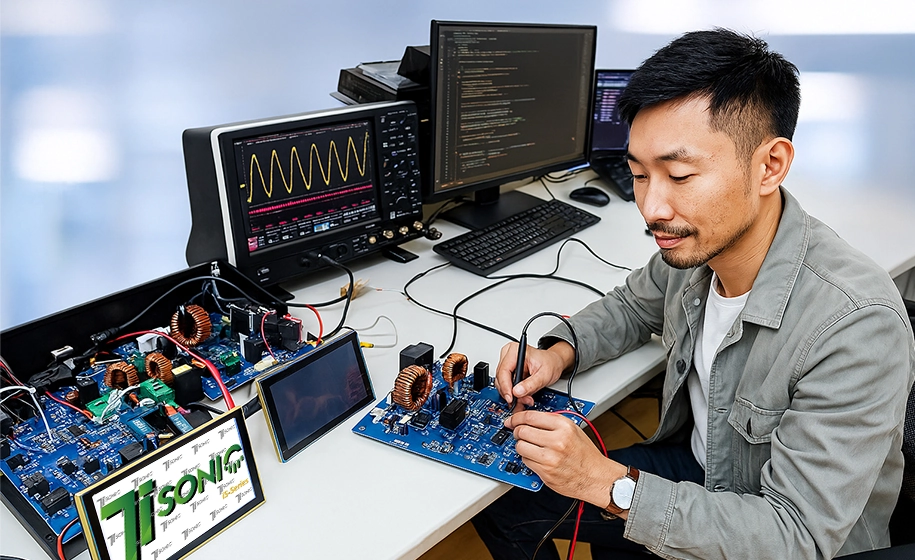
Electronics
Ultrasonic Welding in Electronics Industry White Paper
I. Core Advantages in Electronics
II. Core Application Scenarios
3.1 Wire Harness Terminals & Metal Conductors
Applications: ECU harnesses, BMS wire sets, Copper-Aluminum dissimilar welding.
Advantages: Extremely low contact resistance, no damage to plating, no solder or flux required, achieves high tensile strength.
3.2 Connectors & Sensor Housings
Applications: USB Type-C housings, Automotive radar sensors, Waterproof connectors.
Results: Achieves high airtight/waterproof grades, avoids overflow risk, and protects internal PCBs and components.
3.3 Battery Tabs & Busbars
Applications: Lithium battery tabs (Al/Cu/Ni), Busbars.
Benefits: Low contact resistance, low heat generation, ensures stable high-rate discharge, suitable for EV and ESS.
III. Process Parameters & Traceability
| Item | Typical Parameter Range |
|---|---|
| Frequency | 20kHz / 30kHz / 40kHz |
| Welding Time / Pressure | 0.05 – 1.5 s | 0.1 – 0.6 MPa |
| Traceability Data | Time, Energy, Frequency, Pressure, Displacement, Peak Power |
| Quality Systems | SPC, CPK, MES, IATF 16949 |
IV. Technical Pain Points & Solutions
| Technical Issue | Cause | Professional Solution |
|---|---|---|
| PCB Warpage | Excessive Pressure | Servo pressure closed-loop control |
| Housing Whitening | Excessive Amplitude | Reduce amplitude and welding time |
| Insufficient Airtightness | Poor Joint Design | Optimize Energy Director (Joint design) |
| Weak Metal Tensile Strength | Insufficient Energy | Adopt "Energy Mode" precision control |
Standard Automation Integration Process
Auto Loading → CCD Positioning → Pre-clamping → Ultrasonic Welding → Data Archiving → AOI Inspection → NG Sorting → Finished Product Outfeed
* Continuous 24h production with 6-axis robots and real-time MES feedback.
Conclusion: Mainstream Process for Precision Electronics
Ultrasonic welding has become the core solution for high quality and low cost in the electronics industry. Equipment introduction should prioritize Product Material, Joint Design, Cycle Requirements, and Traceability Specifications.
Benefits: Yield improvement, cycle optimization, elimination of solder costs, and enhanced digital management.
The above article content was generated by AI.