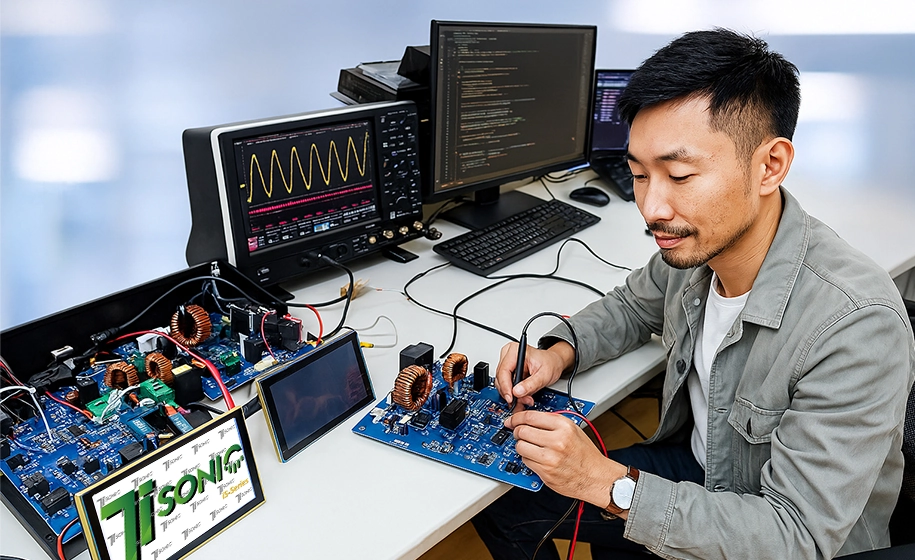
Ultrasonic Welding Solutions for the Aerospace Industry
White Paper on Ultrasonic Welding Applications in the Aerospace Industry
I. Core Values of Aerospace Implementation
II. Interpretation of Key Aerospace Application Scenarios
3.1 Aerospace Wire Harnesses and Avionics Modules
Typical Applications: Aircraft wire harnesses, satellite power supply cable sets, eVTOL powertrain harnesses, and hermetic sealing for avionics.
Core Values: Achieves extremely low contact resistance without the need for solder. Features EMI shielding integration and resistance to high/low-temperature cycling, all without damaging internal precision PCBs.
3.2 Lightweight Alloy Sheets and Thermoplastic Composites (CFRTP)
Typical Applications: UAV fuselage shells, satellite heat sinks, and eVTOL interior panels.
Technical Advantages: Reduces thermal stress and delamination risks. Eliminates the need for adhesive curing wait times. Supports robotic automated continuous welding, as well as rework and re-welding.
III. Process Parameters and Verification Items
| Item | Parameter Range / Verification Recommendations |
|---|---|
| Frequency and Amplitude | 20kHz / 30kHz / 40kHz | 8 – 35 μm |
| Environmental Simulation | Thermal cycling, Vibration (G-force shock), Salt spray |
| Mechanical and Physical Verification | Tensile testing, Contact impedance, Hermetic leak test |
| Recommended Standards | AS9100, FAA/EASA verification processes, MIL-STD wire harness reliability |
IV. Common Technical Pain Points and Solutions
| Technical Challenge | Potential Cause | Professional Improvement Strategy |
|---|---|---|
| Insufficient Harness Tensile Strength | Insufficient Energy | Adopt energy mode monitoring + Tensile sampling |
| Composite (CFRTP) Delamination | Excessive Amplitude | Reduce amplitude and implement segmented welding designs |
| Alloy Sheet Joining Deformation | Excessive Pressure | Servo-controlled displacement closed-loop control |
| Poor Hermetic Sealing | Inadequate Joint Design | Optimize joint structures and utilize high-precision fixtures |
Automation and Data Traceability Architecture (MES/QMS)
Auto-loading → CCD Positioning → Pre-clamping → Ultrasonic Welding → Data Archiving (Welding Waveforms) → Sampling (Tensile/Hermeticity) → Finished Product Outfeed
* Integrates 6-axis robots, barcode traceability, and AOI visual inspection to ensure aerospace-grade quality consistency.
The above content was integrated and generated by AI.